a machine for killing ideas
The Short Version:
A contest asked people to make one AI model run faster on NVIDIA H200 chips. I had no such chip, so my AI agents and I mailed every test to the judge's machine. Our tests mostly proved ideas wrong. The code behind my final score was written by other teams, and this post says so.
On Oct 27 at 5:35 pm my best own file went into the judge and scored 1.314x. Eleven minutes later an unmodified public file went in on my account and scored 2.086x.
That gap is most of this story. I ran the Open Kernel Challenge with a loop of AI agents and no GPU of my own. The loop turned out to be a great machine for killing ideas and a weak machine for finding them. What moved my rank was a search and three forks of public code, with credit. My one graft on someone else's file took me from #60 to #43 for a few hours, and it isn't in my final files. Then I lost my last file to my own process.
I finished #271 of 2,014 on the provisional board. Here's how, with numbers. Times are US Eastern, as my logs have them.
the problem in plain words
The Open Kernel Challenge is run by Paradigm with Meta and Andromeda. The goal: make Meta's Muse Spark Open model serve faster on NVIDIA H200 GPUs. The kernel track ran Oct 22 to Nov 4 and paid no prize money. Its only reward was that the top 50 overall got priority in the queue for the serving track, which holds all $100,000.
A kernel is a small program spread across a GPU's threads. SGLang is the open source engine that serves the model, and its stock kernels are the baseline you race.
One layer of the model is a chain of about 9 steps, and each step needs the last one's result: qkv gate, attention, o projection, a boundary norm, pooler plus router, picking the top 8 experts, the experts themselves, the unpooler, and another boundary norm. The experts step is MoE, mixture of experts: each token goes to 8 of 256 small subnetworks. Think of a bucket brigade. Nobody can pass a bucket they haven't been handed yet.
The weights are stored in NVFP4, a 4 bit format built for NVIDIA's newer Blackwell chips. The H200 is older and has no FP4 tensor cores. So on H200, SGLang has one path, its Marlin fallback, which unpacks the 4 bit codes and then multiplies in BF16, a 16 bit format.
The scoreboard is in microseconds, written us from here on. Each problem is timed at six loads: decode at batch 1, 16 and 32, where each request makes one token, and verify at the same batches, where each request checks an 8 token draft. On the layer problem each load has a sliding window shape and a full attention shape, so 12 shapes. Every shape is captured as a CUDA graph (a recorded list of GPU work that replays with no Python in between) and replayed in turns against SGLang's kernel with a cold cache. Your score is the geometric mean of SGLang's time over yours. SGLang's layer takes 22.62 ms per step.
The overall board shows ranks only. The final boards settle what drives it: I measured that overall rank equals layer rank for every team from #1 to #604. At my level, the layer was the whole game. Entering more problems did nothing. It took me from 808 of 1,174 to 808 of 1,175.
no GPU
My machine is a MacBook Pro with an Apple M4 and 16 GB. No NVIDIA GPU, no nvcc, not even torch installed. So every experiment went to the judge. It was like doing chemistry by mailing every sample to a lab.
The mail was slow. On Nov 3 I measured 7.6 to 7.7 minutes per job round trip. My notes from Oct 27 say 20 to 30 minutes, with a queue backlog over 400. Each problem allowed 10 scored runs and 20 checks a day. A check is the same run, kept off the board.
The mail was also noisy, like weighing a feather on a bathroom scale on a moving bus. I measured 13 pairs of byte identical files. Their whole scores differ by a median of 0.44%, a mean of 0.62% and a max of 2.16%. Single shapes are worse, since the same kernels read 2.063x and 2.231x on one decode 32 shape. keell0renz reports 0.63% standard deviation and says a real 1% change needs 6 to 8 runs per arm. Most of my ideas were worth less than 1%.
Renting an H200 by the hour was an option. I built the prepare lab instead and never rented one. keell0renz reports about 460 logged experiments on the judge plus a Modal H200. My logs show 124 judge jobs.
what my runs really found
Agents built these and I directed. All numbers are judge measurements on my account, and none of this is in my final files.
Marlin block size. SGLang's picker lands on 64 row blocks at 256 tokens. Routing is skewed, so a 64 row block holding 5 real tokens still issues a full multiply, about 13x padding. I swept a cap on the layer: stock 1.039x, cap 32 1.072x, cap 16 1.084x, cap 8 0.998x. That's +4.3% from one tuple. On the MoE problem the same cap reached 1.385x at verify 16. This is my most upstreamable result.
A 12 launch chain. One constant, _MIN_TOKENS_FOR_FUSED = 32, sent smaller batches through 12 to 13 separate launches: 29.5 us at one token, 37% of that shape. Calling the fused kernel at every size took MoE from 1.104x to 1.269x, and decode 1 from 77.1 to 52.3 us.
Router threshold. At 8 tokens a BF16 hi/lo router beat FP32, 14.1 us against 26.3. At 1 token it reverses, 14.4 against 10.5. The right split is 2 tokens, not 8.
See the pattern. My early wins were small batch constants in Python wrappers, not clever kernels.
Attention was about launches, since one removed launch on a 20 to 30 us shape is worth 20 to 30%. Routing attention per shape took it from 1.058x to 1.280x, then 1.482x with a vendored Triton kernel. My best own MoE kernel was raw CUDA at one token, 34.4 us at decode 1, the only own kernel that ever beat Marlin. vjeux's public kernel was already at 25.7.
One direction died outright: ten Triton, TileLang and CuTe attempts at decoding the 4 bit weights, zero wins, including 0.363x. I estimate 16 to 24 ALU ops per weight byte caps that near 0.7 to 1.1 TB/s, against a memory ceiling I measured at 4.40 to 4.54 TB/s.
the prepare lab
prepare() runs once before timing, untimed, for up to 300 seconds, on the judge's own H200. So one run gives about 180 seconds of real GPU time. Agents compiled variants there, timed them as graph replays and printed the results into the log tail. keell0renz describes the same trick. The protocol was A, B, A again, two rounds, and B ships only if it clearly beats the gap between the two A runs.
The set piece was the conveyor belt. Research forecast +2 to +6% for a persistent kernel that runs the whole layer as one belt instead of a chain of separate kernels, at a cost of weeks. That forecast was an estimate. The method reviewer made us model the belt with its barriers first. About 2 seconds of lab time later, I had the measurement: the belt took 60.4 us at decode 1 sliding, a chain of separate kernels 60.7 without PDL and 58.1 with it. PDL, programmatic dependent launch, lets the next kernel start while the last one drains. The idea died in one job.
The same lab split decode 1 sliding's 74.4 us: 37.2 reading bytes at full speed, 4.9 launch, 11.1 from splitting into 9 dependent steps, 18.1 kernel inefficiency, 3.1 handoff. The waste was the dependency, not the launches.
Prefetching the next weights into L2 cache measured slower at every size. A MoE prologue redesign passed deadlock and exactness reviews, then ran about 50 us slower at 128 tokens in the A/B, which shipped nothing. That's the lab working as a safety net.
Behind the lab was the agent loop. My logs show 28 workflows and 658 agent starts, and 90 of them died. A round went: hunt, where readers return hypotheses with arithmetic, then triage, build, adversarial review through 2 or 3 lenses, and fix. Every round appended to a LESSONS.md that the next round read first. My logs count 177 hypotheses from 34 hunts, and 33 of 132 review verdicts refuted the candidate, 25%.
But the reviews caught correctness, not speed under the noise. A MoE latency lever passed three lenses and gained nothing. My latency models delivered 0 to 20% of their predicted gain. Swapping in a kernel that was measurably faster delivered what it predicted.
At least 16 judge jobs carried lab experiments. Only the boundary graft's automatic A/B ever turned something on, and the tuners kept defaults every time. The lab closed ideas and blocked regressions far more than it found wins.
Who did what: I set direction and made the go and stop calls. Agents read, built, reviewed and fixed the code.
the fork
On Oct 27 I went looking for public work. A GitHub code search for the file header okc: problem=muse_ surfaced lee101 and Madhavan113, and Madhavan113's NOTICE named vjeux. At 17:46 vjeux's layer file went in as a check. Minutes later I decided to fork it, with credit.
Every submission is licensed Apache-2.0 by its submitter, and nothing in the rules forbids building on public code. Before scoring, vjeux's files got a license check, 4 off board checks, a study by 14 agents, and rule audits that gated scoring. Result: concerns, no violations.
Here's what the comparison looked like, measured on my account before I forked:
| Problem | My best own file | vjeux's public file |
|---|---|---|
| layer | 1.314x | 2.086x |
| MoE | 1.366x | 2.325x |
| attention | 1.482x | 2.590x |
| proj | 1.168x | 1.482x |
Those files beat my best on every shape of every problem. The layer board showed the same gap that evening, before the fork scored. Tap any screenshot to see it full size.
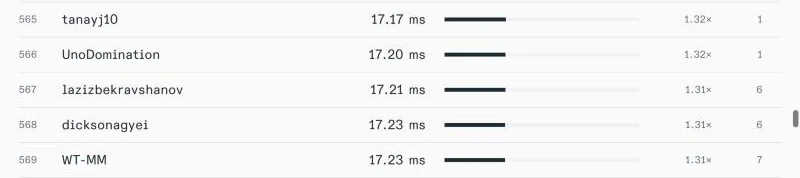
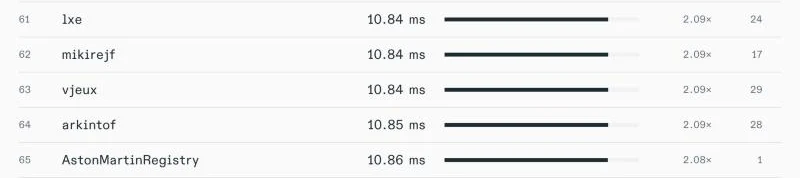
The fork scored 2.089x at 18:08, which put me #60 of 1,360. Then came my one clear win on someone else's base. Per kernel profiles showed SGLang's stock boundary kernels beat vjeux's at 128 tokens, 4.8 plus 4.4 us against 5.8 plus 5.7. A gated graft of those boundaries, plus SGLang's BF16 output on the o projection and unpooler above 32 tokens, where the boundary reads them, took 2.089x to 2.126x at 20:55. That's +1.8% against a predicted +1.0 to +1.7%. By 21:10 I was #43 overall. It was my best rank ever and my only time inside the top 50.
One more credit belongs here. Public kernels store the dense BF16 weights losslessly in 12 bits, so 50.3 MB crosses memory instead of 67.1 MB, and the rules allow it. On my account that pooler ran at one token in 13.1 us, under the published floor of 14.0. The format appears in vjeux's public file and later forks. Its origin isn't clear from my records, and it isn't mine.
how I lost ground
On Oct 28 a short break turned into 8.6 hours, and I came back at #73, scores unchanged. A deep kernel push from Oct 29 to Oct 30, partly unreviewed after reviews died on timeouts and laptop sleep, ended at 2.147x, #150 of 1,690. That overstates my levers: neighbouring files scored 2.110 to 2.132, so I estimate about 2.13 as the fair level.
On Oct 30 I decided the levers needed a real GPU to test, submitted what we had, and paused. Work resumed Nov 3 at 13:43, about 100 hours later, with zero judge jobs in between. Nothing kept watching, and #150 became #393 on the same score.
The search gap hurt more. alygg77's commit sat 4 days 21 hours before I found it, and my Oct 30 search missed it. Code search also missed keell0renz. A repo name search found them about 100 minutes later, 24.6 hours after their push. I estimate that forking alygg77 on Oct 30 would have put me near the top 100 line of 2.198x, with 5 days left.
On Nov 3 the forks took under 2 hours and 10 jobs. alygg77's base gave 2.215x, #315. keell0renz's gave 2.251x, #211 of 1,944. My graft added nothing on alygg77's base, which already had equal or faster versions at every batch size.
Then the last day. The plan was to port attention arms into keell0renz's layer behind an A/B, worth about +0.3% by my estimate, never measured. At 17:39 the upload was refused with no job id: "rejected: submission is larger than 1000000 bytes". The file was 1,166,347 bytes. That cap isn't in the rules text I saved, and I learned it from the refusal. My previous file had run at 999,399 bytes, just 601 under a cap I didn't know about.
From 17:55, API errors ended in ENOTFOUND, and nothing moved until 23:37. The fix: one 138 KB string was a near copy of another with 78 line edits, so slim.py rebuilds it at import from a plain text edit list with a sha256 check. Around 23:56 the file validated locally at 955,571 bytes. Submission waited on a background review. Licensing and safety reviews passed. Exactness never reported. The file was never sent and never ran on any GPU.
My last judge job was Nov 3 at 16:11. From there to the close was 34 hours 48 minutes, with two daily windows of runs and checks unused. Holding the file had no upside, since a failed scored run doesn't hurt the board and the A/B falls back to base. I estimate the cost at about 2.258x and #244 instead of #271, never measured.
That 16:11 job scored 2.261x and never reached the board. It ran a batch 8 MoE port that lost its own A/B, so the same kernels as my board file. The board counts 15 attempts where I count 16 scored layer runs, reason unknown. Counted, it would rank #226.
Meanwhile, on the same score, I went from #211 on Nov 3 to #271 at close. 183 of the 270 teams above me set their best after my last run. 46 of the top 50 set theirs in the final 24 hours.
a disqualified run
Job f95624a05d654f0d, proj, Nov 3: 1.555x, 9 of 9 tests, status passed with empty flags. It was a public Apache licensed proj file I forked, unchanged except my header. It holds 11 base64 plus zlib strings, 61,372 characters, that inflate at import to 150,475 bytes of CUDA and C++ source. Neither I nor my agents wrote that encoding, and I didn't notice it. okc jobs now reads: "disqualified: Contains compressed or encoded source that's decoded at run time. Violates the rules." A plain text file replaced it on proj later that afternoon at 1.585x, so the rank effect was zero. I found it on Nov 6, going through my job history.
That's my vetting failure. vjeux's files got a rule audit before scoring. This fork went from check to scored in about 15 minutes with no audit recorded, and nothing scanned for base64 or zlib. Keep two things apart here: the rules allow compressing weights losslessly. What the judge objected to was compressed source code.
the final table
All ranks here are provisional. The organizers rerun top submissions after the close, on held out data too, and final positions are medians of those reruns. I don't know whether #271 gets rerun.
| Board | Mine | Rank | Ranked teams | #1 | #50 | #100 |
|---|---|---|---|---|---|---|
| layer | 2.2508x | 271 | 1,299 | 2.6144 | 2.3964 | 2.3079 |
| MoE | 2.3936x | 236 | 1,425 | 2.8438 | 2.5269 | 2.4453 |
| attention | 2.649x | 201 | 1,379 | 3.3389 | 2.8093 | 2.7131 |
| proj | 1.5851x | 136 | 1,746 | 1.7277 | 1.6046 | 1.5924 |
| overall | ranks only | 271 | 2,014 |

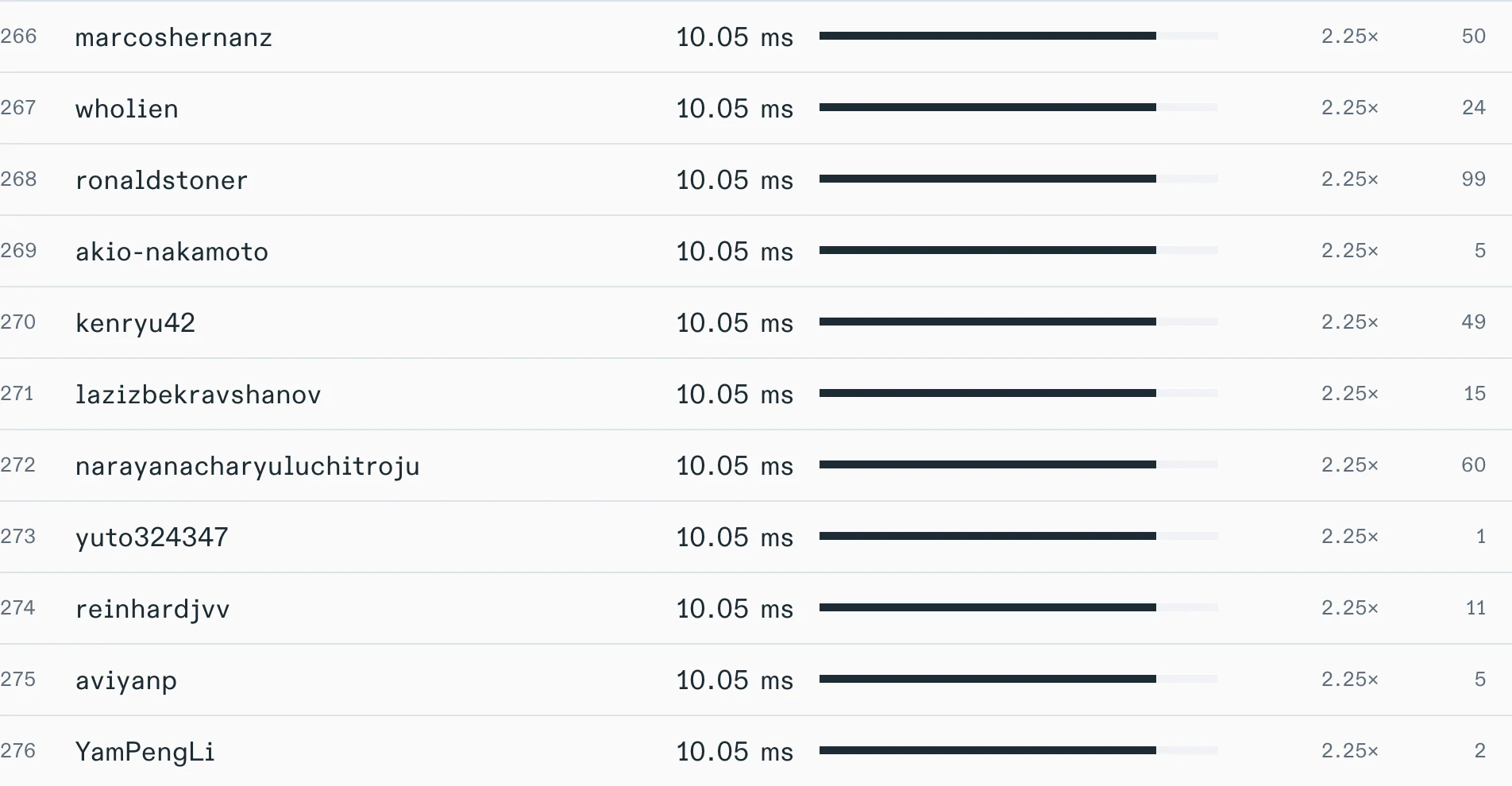
The layer runs at 10.05 ms per step against SGLang's 22.62. The best shape is decode 1 sliding, 66.4 us against 171.8, 2.59x. The worst is decode 32 sliding, 146.3 us against 266.1, 1.82x. From 2.2508, #100 needed +2.5% and #50 needed +6.5%. 224 other teams sit within plus or minus 1.5% of my score, the judge's own interval.
All four files on the board are keell0renz's, byte for byte, plus my 6 line attribution header. None of the kernels behind my final score are my design. Of the +0.937x between my own 1.314x and the final 2.251x, I estimate forks gave about 0.88x. My levers added roughly +0.04x on vjeux's base, and none of that survived into the final files.
what a GPU would have changed
The times in this section are my estimates, built from the measurements above.
My logs show 124 judge jobs. At the 7.6 minutes per round trip I measured on Nov 3, that's about 15.7 hours of waiting, and on Oct 27 the round trip was 20 to 30 minutes. A rented H200 would turn an experiment around in about a minute. The same 124 experiments would take about 2 hours.
Speed matters less than count. keell0renz says a real 1% change needs 6 to 8 runs per arm, so one honest A/B is 12 to 16 runs. On the judge, with 10 scored runs and 20 checks a day per problem, that's most of a day's checks for one idea. On my own H200 it's about 15 minutes. Most of my ideas were worth less than 1%, so most of them were never measured well enough to keep or kill.
Here's what I'd have done with one:
| Job | On the judge | On a rented H200 |
|---|---|---|
| one A/B at 8 runs per arm | 16 jobs, about 2 hours, most of a day's checks | about 16 minutes |
| my 124 jobs | about 15.7 hours of round trips | about 2 hours |
| first run of the attention port | never happened | about 1 minute |
- Confirm the Marlin cap. +4.3% from one tuple is my most upstreamable result. Before I sent it to SGLang, I'd want it measured at 8 runs per arm on every shape.
- Profile, don't infer. The lab split decode 1 sliding into parts from timers printed in a log tail. 18.1 us of that was kernel inefficiency. A profiler, a tool that reads the GPU's own counters for each kernel, would say where those 18.1 us go instead of leaving me to guess.
- Run the attention port once. It validated locally at 955,571 bytes and never ran on any GPU. I don't know whether it is correct or fast. With a GPU I would know in a minute.
None of this says #271 would move. keell0renz had the judge plus a Modal H200 and logged about 460 experiments to my 124. A GPU buys more measurements, not better ideas. But measurements were the thing I was short of, so this is the first thing I'd buy next time.
what I'd do differently
- Search by code and by repo name on day one, then every 12 hours, on a schedule that survives pauses.
- Rent an H200 by the hour for the first week.
- Build the prepare lab first, and measure a bare skeleton of the same bytes before tuning, as keell0renz's LESSONS advises.
- Put the layer first, since overall follows it. Refuse any lever under about 3% unless per kernel rows or a paired A/B confirm it.
- Near a deadline, submit on validate with reviews running alongside. Never leave a finished file waiting on a background job.
- Rule audit every new base, grep for base64, zlib and exec, read
okc jobsevery loop, and add a size check. - Treat a pause as a handoff, and leave a watcher running.
credits
Code in my files came under Apache-2.0 unless noted. keell0renz's NOTICE lists this chain.
- vjeux, github.com/vjeux/okc-2026: the starting point of every board, per keell0renz's NOTICE. Persistent MoE kernel, in register NVFP4 decode, fused attention.
- alygg77, github.com/alygg77/okc-muse-spark-kernels: layer and MoE bases, including no first boundary at one token.
- keell0renz, github.com/keell0renz/muse-open-kernel-challenge: the four files behind my final board, per batch size MoE builds, and a public LESSONS.md worth reading. Their README says some of their own rows are high draws of these files.
- chenwainuo, github.com/chenwainuo/okc: GEMVs for large batches.
- ZhimaoL, github.com/ZhimaoL/sglang: verify attention kernels. keell0renz says those branches were deleted Nov 1.
- Madhavan113, github.com/Madhavan113/ParadigmKernelChallenge: attention merge. keell0renz's NOTICE lists it under Apache-2.0. GitHub showed no license on that repo when I looked on Oct 28, Oct 30 and Nov 3, and its own NOTICE says the files derive from vjeux's Apache code with modifications copyright Madhavan113. My Oct 30 log treated it as ideas only, yet keell0renz's attention file on my board includes their bulk merge.
- NathenFernandes, github.com/NathenFernandes/muse-bf16-proj: proj kernels, MIT.
- matvey (kernarc) and zhebrak: cuBLASLt plan pins and stream K cost settings, credited in keell0renz's files.
- Not in my files, but part of the path: lee101, github.com/lee101/openkernels, for H200 notes. PostTrainLLM, github.com/PostTrainLLM/posttrainllm, issue 206, a public two day attempt that reached 1.11x.
- Baselines: SGLang and gpu-mode.
I have no public repo for my forks.
The close was Nov 4 at 11:59 pm Pacific. The winning layer run landed 28.7 minutes before it. My last file was still on my laptop.