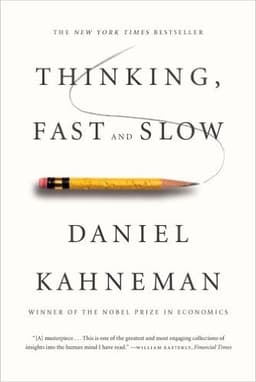
Thinking, Fast and Slow
Daniel Kahneman
What changed how I think:
“Nothing in life is as important as you think it is, while you are thinking about it.”
Why I picked it up
I wanted to understand cognitive biases — not just know their names, but understand why our brains are wired to make predictable mistakes. As someone building with AI, understanding human cognition felt essential.
The core idea
Your brain operates in two modes:
System 1 — fast, automatic, intuitive. It's the part that finishes sentences, recognizes faces, and makes snap judgments. It's efficient but easily fooled.
System 2 — slow, deliberate, analytical. It's the part that solves math problems, weighs pros and cons, and plans ahead. It's accurate but lazy — it avoids effort whenever possible.
Most of our mistakes happen because System 1 handles things that System 2 should be doing. We jump to conclusions, trust our gut when we shouldn't, and confuse ease of recall with truth.
What changed for me
I started noticing my own biases in real-time. When I feel strongly about something, I now ask: is this System 1 talking? Do I actually have evidence, or do I just feel certain?
The anchoring effect chapter was especially useful for understanding negotiations and estimates. The first number you hear shapes everything after it — even when it's completely irrelevant.
The AI connection
This book made me think differently about AI alignment. If humans can't even align their own two brain systems, how do we align AI with "human values"? Which system's values? The gut reaction or the reasoned analysis? This question keeps me up at night — in a good way.
Who should read it
Anyone who makes decisions — so, everyone. It's dense but life-changing. Read it slowly, one chapter at a time. Let each idea sink in before moving on.